The best Kenya motorcycle tour routes are not the ones that cover the most kilometres. They link red dirt tracks, private conservancies and quiet rural roads into days you can actually enjoy, with help close by when something goes wrong. Our 8-day 2027 Safari Loop is built on that idea: small groups of up to eight riders, around 80% off-road, and a doctor and mechanic on every trip.
Below you will find what shapes a good route in Kenya, the kinds of terrain you will meet, how daily distances really work, and what to look for before you pay a deposit.
Ride Kenya With Us in 2027
Max eight riders, about 80% off road, with a doctor, a mechanic and a support car along for the ride. 12 to 19 June 2027.
TL;DR
- A good Kenya route mixes terrain types: murram (graded red dirt) roads, rocky tracks, sandy riverbeds and a little tarmac to link them.
- Private conservancies and restricted areas give you riding that ordinary tourist routes never reach, with wildlife next to the track.
- Daily distance matters less than riding time. Kenyan roads are slow, so plan for hours in the saddle, not kilometres.
- Support decides how far a route can safely go: a mechanic, a doctor and a support vehicle let you ride remote trails with confidence.
- Our 2027 Safari Loop costs €2,785 per rider, and we run it with a maximum of eight riders.
Table of Contents
- Why the route matters more than the bike
- The terrain you will ride in Kenya
- Four regions that shape most Kenya routes
- Private conservancies: the part tourist routes miss
- How long is a riding day in Kenya?
- The support behind the route
- The 2027 Safari Loop: our 8-day route
- When to ride your route
- What to check before you book any Kenya route
- What it feels like on the track
- FAQ
- Sources
Why the route matters more than the bike
Most riders who ask about Kenya routes are really asking one thing: where will I be riding, and will it be worth the flight?
Kenya answers well. The country packs highlands, the Great Rift Valley, dry bush, volcanic landscapes and big wildlife country into distances a motorbike can link in a week. But the same country has long stretches of dull, fast tarmac and heavy truck traffic. A route that simply joins the dots between famous names will put you on exactly those roads.
A route built by people who know the country does the opposite. It looks for the track beside the highway, the farm road through the hills, the conservancy gate that opens only for a small group. That is how we plan ours: Raj lives in Kenya and Hidde lived there for years, and we scout the tracks ourselves rather than copying a brochure.
The terrain you will ride in Kenya
Before you judge any route, know what you will be riding on. Four surfaces cover most of it.
Murram roads
Murram is the graded red-brown dirt that links most villages. Good murram is fast and fun. Wet murram is slick. Freshly graded murram can be loose and deep in the middle. Corrugations (washboard ripples) shake everything, so speed and a light grip on the bars help.
Fesh fesh
Fesh fesh is the local word for fine, powdery dust that hides ruts and holes. It floats up behind the rider in front. Leave a big gap, ride in the clean air and keep your eyes well ahead. This is the main reason group spacing matters on dry-season routes.
Rocky tracks and riverbeds
This is where the riding gets technical. Volcanic rock, dry riverbeds and sandy crossings reward momentum and standing on the pegs. A route that includes them is a real off-road route, not a tarmac tour with a few dirt shortcuts.
Tarmac links
You will use some. Kenyan tarmac is not European tarmac: potholes appear out of nowhere, sleeping policemen (speed bumps) sit unmarked at the edge of every town, goats and cattle wander on, and matatus (minibus taxis) overtake on blind corners. As a rule, the biggest vehicle wins. A good route keeps these sections short and tells you how to ride them. Our off road terrain guide goes deeper on each surface.
Four regions that shape most Kenya routes
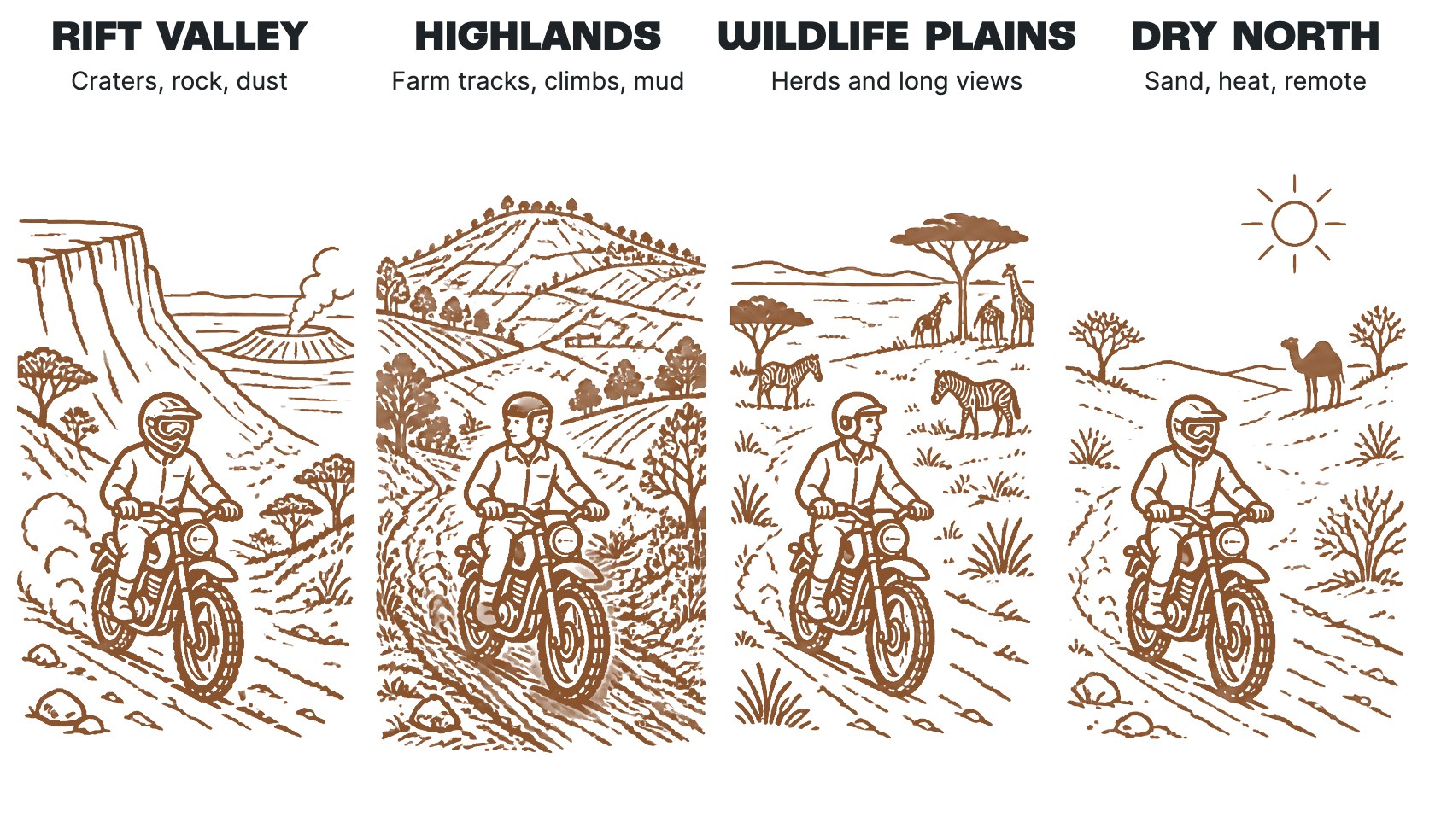
You do not need a full map. Most good itineraries draw on four types of country.
The Rift Valley. Big escarpments, volcanic craters and wide floors that run through the middle of the country. It gives some of the most dramatic scenery, and plenty of loose rock and dust to ride through.
The central highlands. Cooler, greener and more farmed. Expect small tracks between fields, steep climbs and mud after rain.
The wildlife plains. Open savannah with grazing herds, big skies and long views. This is where a motorbike becomes something special, because you hear and smell the bush in a way a closed jeep cannot give you. We explain this in 7 reasons to skip the jeep.
The dry north. Remote, hot and sparse, with sandy tracks and few services. Not a place for a rider alone with a puncture.
A week-long route can touch several of these. The skill is choosing how much time to spend in each, so that no day is only a transfer.
Private conservancies: the part tourist routes miss
A conservancy is a protected area of land managed for wildlife, usually in partnership with the landowners or local communities who live there. In northern Kenya, community conservancies are supported by the Northern Rangelands Trust, an organisation owned by the communities themselves.
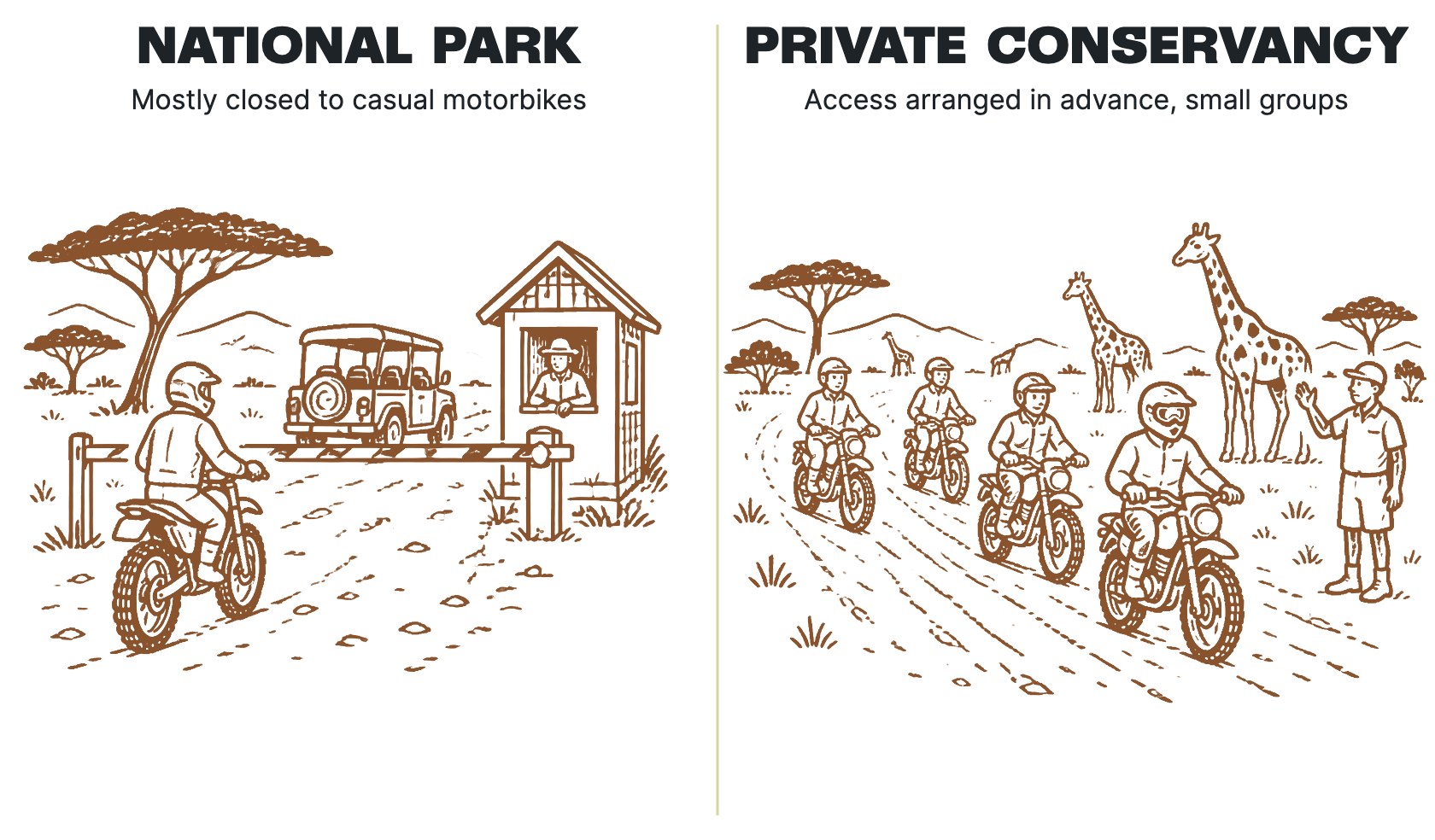
Why does this matter for a rider? Access. National parks have their own rules on vehicles, and most are not open to casual motorbike riding. Private conservancies and restricted zones are different: access is arranged, and your group is small enough to ride them lightly.
Our expeditions include exclusive access to private conservancies and restricted zones. That is where riding with a giraffe beside the track stops being a photo from a car window and becomes your morning. Read more in our guide to riding private conservancies in Kenya.
How long is a riding day in Kenya?
Riders planning their own routes often make the same mistake: they divide the total distance by the number of days. Kenya does not work like that.
Two hundred kilometres on tarmac in Europe is a morning. Two hundred kilometres of murram, rock, potholes and village traffic can fill a long day. Add stops for photos, a puncture, a herd of cattle on the track and a late lunch, and the hours fly by. On the Safari Loop our days run from about 50 to 230 km, roughly two to seven hours including breaks.
So plan in hours:
- Easy days: four to five hours in the saddle, with time for wildlife and a proper lunch.
- Big days: six to seven hours, with breaks every 90 minutes.
- Never ride in the dark. Livestock, unlit trucks and potholes make night riding a bad idea.
A route with realistic days also leaves room to ride pole pole, which means slowly in Swahili. It is the right speed for dust, rocks and wildlife.
The support behind the route
A route is only as ambitious as the help available on it. This is the part that separates a trip you enjoy from one you survive.
On every expedition we run, you get:
- A mechanic. Chains, tyres, levers and the odd bent footpeg get fixed on the spot, not left for a boda boda mechanic in the next town.
- A doctor. Remote tracks are far from hospitals. Having medical help in the group means problems are handled early.
- A support vehicle. Luggage, spares, water and a seat if you need a rest all travel in it.
- Airport transfers and full board. You land, we collect you. Food and rooms are covered, so you think about riding and nothing else.
Because of this, the route can include trails that would be a poor idea for a lone rider. For a straight answer on risk, read is it safe to ride a motorbike in Kenya.
The 2027 Safari Loop: our 8-day route
Our flagship Kenya trip is the 2027 Safari Loop, an 8 day loop from 12 to 19 June 2027 with around 80% off road riding. It is designed for riders who want scenic days, a bit of a challenge and plenty of wildlife, and who like the idea of a small group. No racing, no heroics: anyone comfortable on a bike and relaxed on gravel will be just fine.
Here is what defines it:
- Maximum eight riders, so the group stays quick and friendly.
- Exclusive routes through private conservancies and restricted areas.
- Local experts guiding you on the ground.
- Full board accommodation, including nights at Doc’s Eco Camp.
- Mechanic, doctor, support vehicle and airport transfers included.
The price is €2,785 per rider. Optional extras are a single room supplement at €295, a bike upgrade at €275 and an extra night at Doc’s Eco Camp at €50 per person. We also run a limited number of expeditions each year, so places are not unlimited.
If Kenya is not what you have in mind, we also run the 2027 India Special Edition in Ladakh at €3,450 per rider, and we can build custom itineraries on request.
Fancy Riding It Yourself?
Tell us who is coming and what you would like. We will take it from there.
We keep the details for each date on our 2027 tours page. If you want to see how a trip like this fits your riding level, start at Plan Your Ride.
When to ride your route
Season changes everything. The dry months give fast, dusty tracks and clearer views. The rainy months turn murram into mud and make some tracks hard going, though the landscape turns green. Pick the month first, then judge the route against it. Our month by month guide explains what each period feels like on a bike.
What to check before you book any Kenya route
When you compare itineraries, ask these questions of each one:
- How much is genuinely off-road? Our figure is around 80%. A vague “mostly dirt” is not an answer.
- Who designed it? Riders who live and ride in Kenya know which tracks are open and which gates will let you through.
- How big is the group? Fewer riders means less dust, quicker days and easier access to private land.
- What is on the support vehicle? A mechanic and a doctor are not the same as a driver.
- What is included? Rooms, meals, transfers and support should be in the price, so there are no surprises on arrival.
- What are the riding hours? Look for days you can finish in daylight.
For paperwork such as visas, licence and insurance, our guide to the Kenya motorcycle trip basics covers what you need to sort before you fly.
What it feels like on the track
The best moment in a route is rarely the famous one. It is the red track at seven in the morning, the engine ticking as it cools at a gate, a herd moving off the road ahead of you, a crowd of children waving from a village school. And at the end of it, a cold drink round the campfire with folk who were strangers a few days ago. A route that leaves space for all that is worth far more than a longer one that does not.
If you are weighing up where in Africa to ride first, see why Kenya is the best start for Africa motorbike tours. And if you are curious how we are different from other expeditions, five reasons sets it out.
FAQ
What is the best route for a motorcycle tour in Kenya?
The best route is one that mixes murram roads, rocky tracks and private conservancy riding, with short tarmac links and realistic daily hours. Our 8-day 2027 Safari Loop follows that pattern, with around 80% off-road riding and a maximum of eight riders.
How many kilometres a day can you ride in Kenya?
Think in hours, not distance. Four to six hours of riding is a comfortable day on mixed terrain, and the kilometres you cover will vary with surface, dust and wildlife stops. Never plan to ride after dark.
Do you need off-road experience for a Kenya motorbike route?
Some experience on loose surfaces helps, because murram, sand and rock are the main terrain. You will be riding in a small group with a mechanic and doctor behind you. Our Plan Your Ride page will help you judge where you stand.
Can you ride through private conservancies in Kenya?
Yes, where access is arranged. Our expeditions include exclusive access to private conservancies and restricted zones, which ordinary tourist routes do not reach.
What is included in a guided Kenya motorbike tour with you?
The 2027 Safari Loop includes full board accommodation, a mechanic, a doctor, a support vehicle and airport transfers. A single room, a bike upgrade and an extra night at Doc’s Eco Camp are optional extras.