For off road touring, choose soft, roll top luggage with welded seams, and put everything that must stay dry inside smaller dry bags within it. Keep the load low, central and balanced, and carry a short repair kit and a chain routine you can actually do at the end of a dusty day. Hard panniers suit tarmac heavy trips. Soft bags suit tracks, spills and the kind of riding we do in Kenya. And if you ride with us, it gets even simpler: your bag goes in the support car and the bike stays light.
Ride Kenya With Us in 2027
Max eight riders, about 80% off road, with a doctor, a mechanic and a support car along for the ride. 12 to 19 June 2027.
TL;DR
- Off road, soft luggage wins: it is lighter, slimmer and kinder to you and the bike in a fall. Hard cases suit road touring.
- Look for roll top closures, welded or taped seams and strong buckles and straps. Then line the inside with small dry bags anyway.
- Pack low, centred and balanced: heaviest items at the bottom and towards the front, left and right close in weight.
- Carry a compact repair kit and lube the chain at the end of each dusty day.
- On our Kenya trips you carry almost nothing on the bike. Your luggage rides in the support car, so bring one soft, waterproof or water repellent bag. Please leave the hard suitcase at home.
Table of Contents
- What “waterproof” has to mean on a tour
- Soft or hard: which suits you
- Roll-bags, tail bags and dry bags
- How to pack panniers and bags
- A repair kit that fits in a bag
- Chain care on tour
- How luggage works on our Kenya trips
- Riding with a support team changes what you carry
- FAQ
- Sources
What “waterproof” has to mean on a tour
A shower-proof tail bag is fine for a commute. Touring is harsher. One adventure-touring luggage guide describes real touring waterproofing as surviving hours of rain, mud, water crossings, rear tyre spray, wet gloves and damp campsites, not just a drizzle.
That is a useful bar. Ask of any bag: will it still be dry after six hours of spray from my own back tyre, and after being dropped in a stream crossing?
A practical checklist, based on a UK luggage buying guide:
- Roll-top closures
- Welded seams
- Waterproof materials
- Secure buckles
- Strong mounting straps
The same guide adds the habit that matters most: even with waterproof luggage, pack important items in smaller dry bags or waterproof liners. Passport, phone, spare gloves, sleeping layer. Each gets its own bag. If the outer bag fails, you lose nothing important.
Soft or hard: which suits you
This is the first decision, and it depends on where you ride.
| Soft luggage | Hard panniers | |
|---|---|---|
| Best for | Off-road, tracks, camping | Tarmac-heavy touring |
| In a fall | Absorbs impact, no trapped leg | Rigid, can make a fall harsher |
| Security | Easy to carry indoors at night | Generally more lockable |
| Waterproofing | Needs good seams or a liner | Moulded edges and gaskets resist water well |
| Weak point | Can vibrate loose on bumpy tracks | A damaged lid can lose its seal |
The table draws on MCN’s touring gear guide, which says hard panniers are generally more lockable and make it easier to lift a fallen bike. A damaged lid can lose its watertight seal. Soft luggage is cheaper and absorbs impact better in off-road spills, but it usually needs separate dry liners, and soft panniers have been reported to vibrate off racks on bumpy ground.
Adventure Bike Rider’s packing guide agrees that soft luggage is the better choice off-road because it weighs less, has a slimmer profile and reduces the chance of damage to bike or rider in a spill.
For 80% off road riding, that settles it: soft. Hard boxes and a dusty track are not a happy marriage.
Roll-bags, tail bags and dry bags
The three shapes do different jobs.
Roll-bags and duffels. One big waterproof tube strapped across the rear seat or rack. MCN’s roll-bag guide says a roll-bag must be waterproof, with premium bags using Cordura and many others PVC tarpaulin. It also warns that extra features add potential failure points, and that you should budget for bungees or ROK straps if straps are not included.
Smaller dry bags. One UK touring guide suggests 30L to 40L roll-top duffel-style bags for camping tours, and 5L to 10L roll tops that fit inside panniers. Those little ones are your organisation system. Colour-code them: red for electronics, yellow for clothes.
Add-on rain covers. Treat them as a back-up, not a plan. XLMOTO’s UK luggage guide says rain covers shift in crosswinds, collect water in folds and can tear when flapping against the bike.
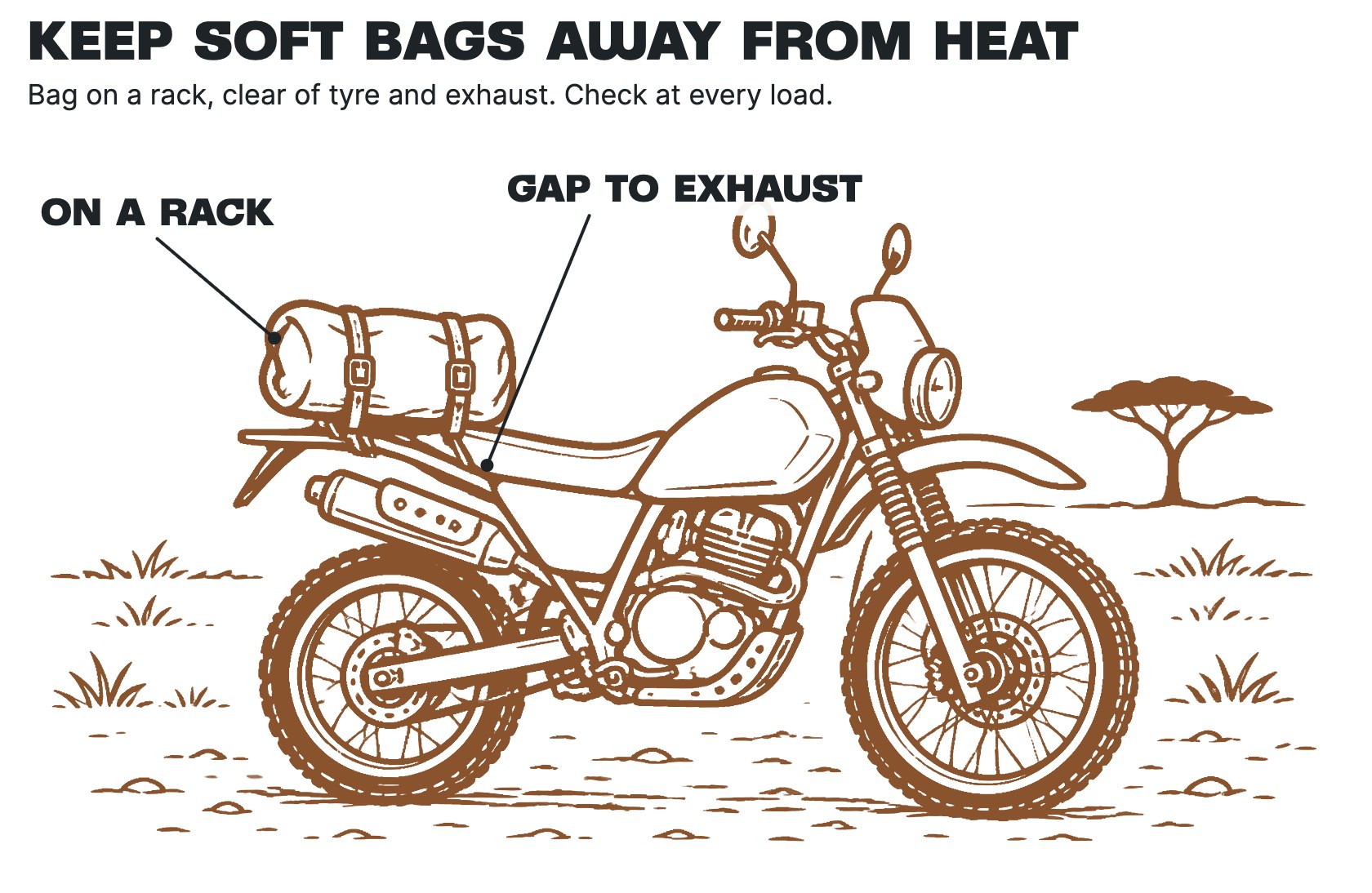
Keep soft luggage away from heat
This is a safety point, so it stays in full. Soft bags can foul the rear wheel and can catch fire near high-level exhausts. Bikesocial’s long-distance preparation feature cites a roll-bag fire on a Husqvarna TR650. Check clearance from the exhaust and the tyre every time you load, and use a heat shield or rack that holds the bag clear.
Sharp things wear through
Adventure Bike Rider’s soft luggage review notes that waterproof soft bags need taped or welded seams and water-resistant zips or weatherproof flaps. It also says sharp items inside can wear through the outer fabric. Wrap tent pegs, tools and stove parts in a cloth or tool roll before they go in.
How to pack panniers and bags
The rule is short. Low, centred, balanced.
MCN’s packing guide puts it in terms of a “Load Triangle”: keep left and right panniers fairly equal in weight, with the heaviest items at the bottom and towards the front of each. Then check your tyre pressure once the bike is loaded.
The reasoning is simple. A high, rear-heavy load makes the bike light at the front and twitchy on loose surfaces. Adventure Bike Rider’s Paul Jennison argues for keeping the centre of gravity as low as possible, with heavier items at the bottom and near the engine, lighter ones on top.
A loading order that works:
- Bottom and front of each bag: tools, spares, tyre pump, chain lube, tin food.
- Middle: clothes in dry bags, spare layers, washbag.
- Top, easy to reach: waterproofs, gloves, snacks, water, first-aid items.
- Tank bag or pocket: passport copy, phone, sunglasses, a small tool for quick roadside fixes.
Put your rain gear on top. You do not want to unpack the whole bag in a downpour to find your jacket.
Pack less than you think
MCN lists the common packing mistakes: overpacking or underpacking, bad weight distribution, luggage not secured properly, not planning gear for the conditions, forgetting important things and packing in a hurry.
Overpacking is the big one. Nathan Millward suggests making a must-take list before the trip and resisting additions, and dividing the panniers into “living areas” such as kitchen, bedroom and wardrobe. Another UK guide says every item should earn its place by doing more than one job: a microfibre towel doubles as a cleaning cloth, a power bank covers phone, sat nav and helmet comms.
A test we like: lay it all out the night before, then take away a third.
Check it before every riding day
Straps loosen on rough ground. Every morning and after every fuel stop on a track:
- Tug each bag hard from the corners.
- Check the roll-top is folded at least three times and the buckle is clipped.
- Look at the exhaust and rear tyre clearance.
- Check nothing has rubbed through the fabric.
A repair kit that fits in a bag
On a remote ride you fix small things yourself. MCN’s touring pack list is a good base:
- Multi-tool with pliers, plus a wrench and socket set, hex keys, spanners and screwdrivers
- Tyre repair kit, spare inner tube or puncture sealant, and a tyre pump
- Cable ties and duct or electrical tape
- Lubricants and common spare parts
- Microfibre cloths and cleaning wipes
MCN also advises servicing the bike before a big tour. Chains need cleaning and lubing as miles add up, tyres may puncture, and nuts and bolts can work loose on varied surfaces. Adventure Bike Rider adds the right size sockets and grease for bearings for when you leave civilisation behind.
Two extras worth the space: a master link that fits your chain, and a spare valve with a valve tool if you ride tubeless. Keep the tools in a roll, not loose. Loose steel in a soft bag is how seams get cut.
Fuel. Water. Tools and spares. That is the order of priority when you are a long way from a boda boda mechanic.
Chain care on tour
A dry, gritty chain wears fast. The routine is quick:
- Brush off the dirt with a proper chain brush, never a wire brush, which can nick and tear O-rings.
- Wipe it clean with a cleaner that is safe for your chain type.
- Let it dry.
- Apply a light, even film of lube to the inner face while rotating the wheel.
- Check slack against the figure in your manual.
A chain guide published in 2026 suggests lubing a warm chain at the end of the riding day, so the lube has the night to settle. It also says rain strips lube and dust is harder on a chain than rain, so on dusty or off-road tours riders often re-lube at the end of every riding day, rather than waiting for a mileage figure. Check your own manual for the interval and the lube your chain type needs.
Keep the lube and a rag in the top of a bag, away from your clean clothes. A leaking can is a classic way to ruin a dry bag’s contents.
How luggage works on our Kenya trips
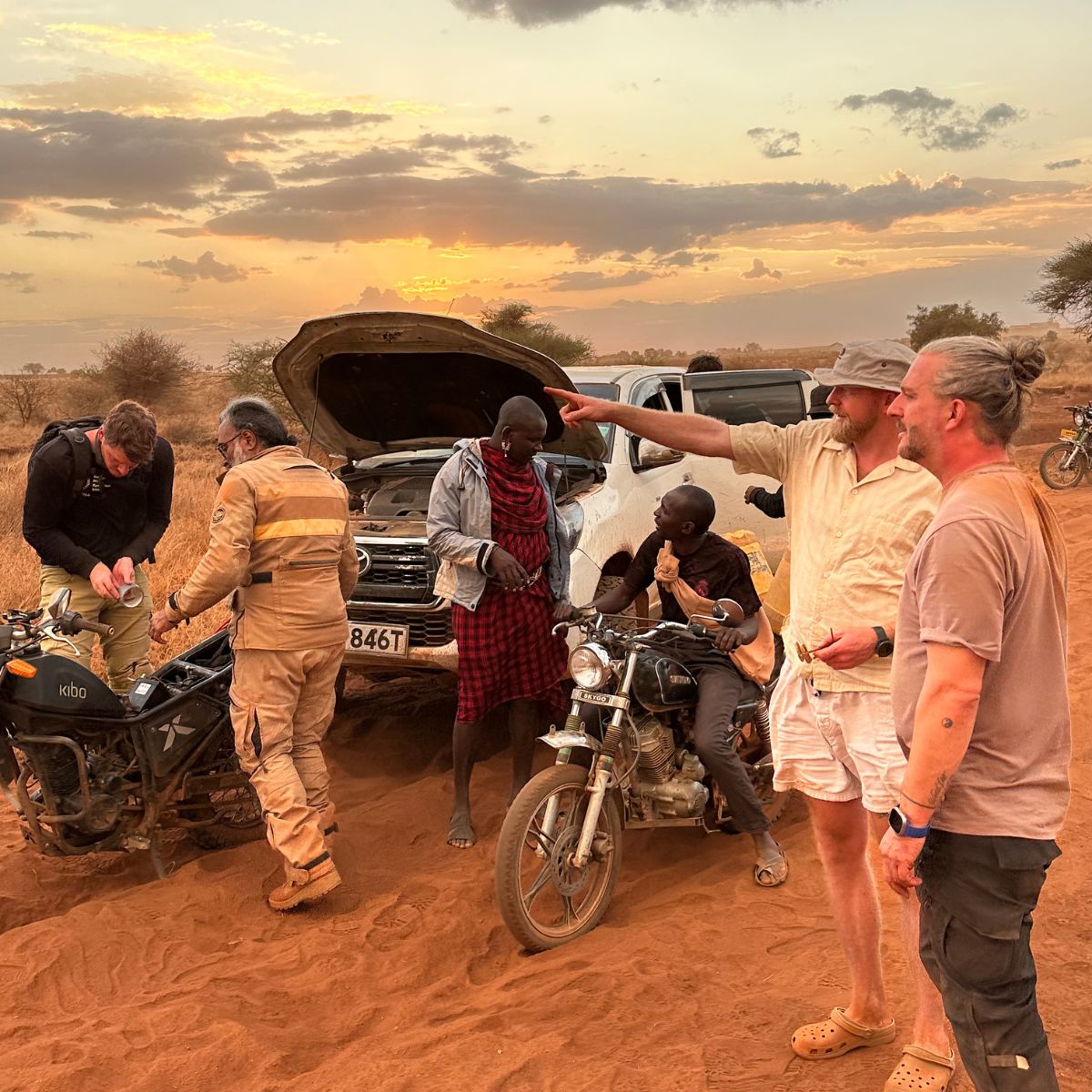
On our expeditions you do not strap your life to the bike. Your main bag travels in the support car, which follows the group every day. That keeps the bikes light and nimble on the tracks, which you will be very glad of in deep sand.
A few things still matter:
- Bring one soft bag: a duffel or a big rucksack. It gets loaded and unloaded every day and lives in a car full of dust, so waterproof or at least water repellent is best. A roll top duffel is ideal.
- Please, no suitcases. Hard cases and wheelie bags are a proper nuisance to stack in a support car, and wheels and dirt tracks were never friends.
- Pack your clothes in a few dry bags inside, so a dusty day or a sudden downpour never reaches your clean shirt.
- Carry a small daypack or a jacket with pockets for the riding day: water, sunscreen, sunglasses, phone in a waterproof pouch, and a rain jacket.
The dust is the real enemy. Fine red powder, called fesh fesh, gets into zips and seams, and murram roads shake everything. A soft bag with a simple roll top shrugs it off. Nothing to jam, nothing to crack.
If you want to see what riding there is like, our practical guide to riding in Kenya covers terrain and conditions, and the Bikes & Equipment page shows what we ride with.
Riding with a support team changes what you carry
Solo, you carry everything: tools, spares, first aid, enough kit for every breakdown. On our expeditions you do not. Each group travels with a mechanic, a doctor and a support vehicle, and trips are limited to a maximum of eight riders. You pack for your own riding day: rain jacket, water, camera, sunscreen, a small dry bag for valuables. The rest is the support car’s problem.
That makes for a lighter, safer bike on the tracks, and a lot more attention for the giraffe next to the road.
The 2027 Safari Loop
Our 2027 Safari Loop is a guided Kenya expedition with about 80% off-road riding, access to private conservancies and restricted zones, full board accommodation and airport transfers. It costs €2,785 per rider. A single room supplement is €295, a bike upgrade is €275, and an extra night at Doc’s Eco Camp is €50 per person. See the full itinerary on the 2027 Safari Loop page.
Fancy Riding It Yourself?
Tell us who is coming and what you would like. We will take it from there.
Our 2027 India Special Edition costs €3,450 per rider, and custom trips are available on enquiry. Both are on our 2027 tours page. For visas, licence, insurance and kit questions, start with our Kenya trip planning guide.
FAQ
Are soft panniers really waterproof?
The best are, if they have welded or taped seams and roll-top or weatherproof closures. Even so, pack your important items in smaller dry bags or liners. That way one failed seal never means a soaked passport or phone.
Hard or soft luggage for off-road riding?
Soft. It is lighter, slimmer and less likely to trap your leg or damage the bike in a fall. Hard panniers are more lockable and suit mostly tarmac touring.
How should I pack panniers so the bike stays stable?
Keep weight low and central, with the heaviest items at the bottom and towards the front of each pannier. Keep left and right close in weight, and check tyre pressure once the bike is loaded.
What should a touring repair kit include?
A multi-tool and socket set, tyre repair kit and pump, spare tube or sealant, cable ties, tape, lubricants and a master link for your chain. Service the bike before you set off.
How often should I lube my chain on an off-road tour?
On dusty or off-road tours, many riders re-lube at the end of each riding day, because dust and rain strip lube quickly. Follow your manual for the lube and interval suited to your chain.
Sources
- Motorcycle Luggage Guide 2026, Moto Central
- MCN’s touring gear guide
- MCN: best motorcycle rollbags
- MCN: how to pack a motorcycle for touring
- MCN: touring pack list
- Adventure Bike Rider: how to pack your motorcycle for an adventure
- Adventure Bike Rider: soft luggage review
- Bikesocial: preparing your motorcycle for a long distance road trip
- Essential guide to motorcycle touring the UK, Roadskin
- Choosing the right motorcycle luggage, XLMOTO
- Best soft motorcycle luggage for ADV touring, Enduristan
- How to clean and lube a motorcycle chain, Bikes and Bays