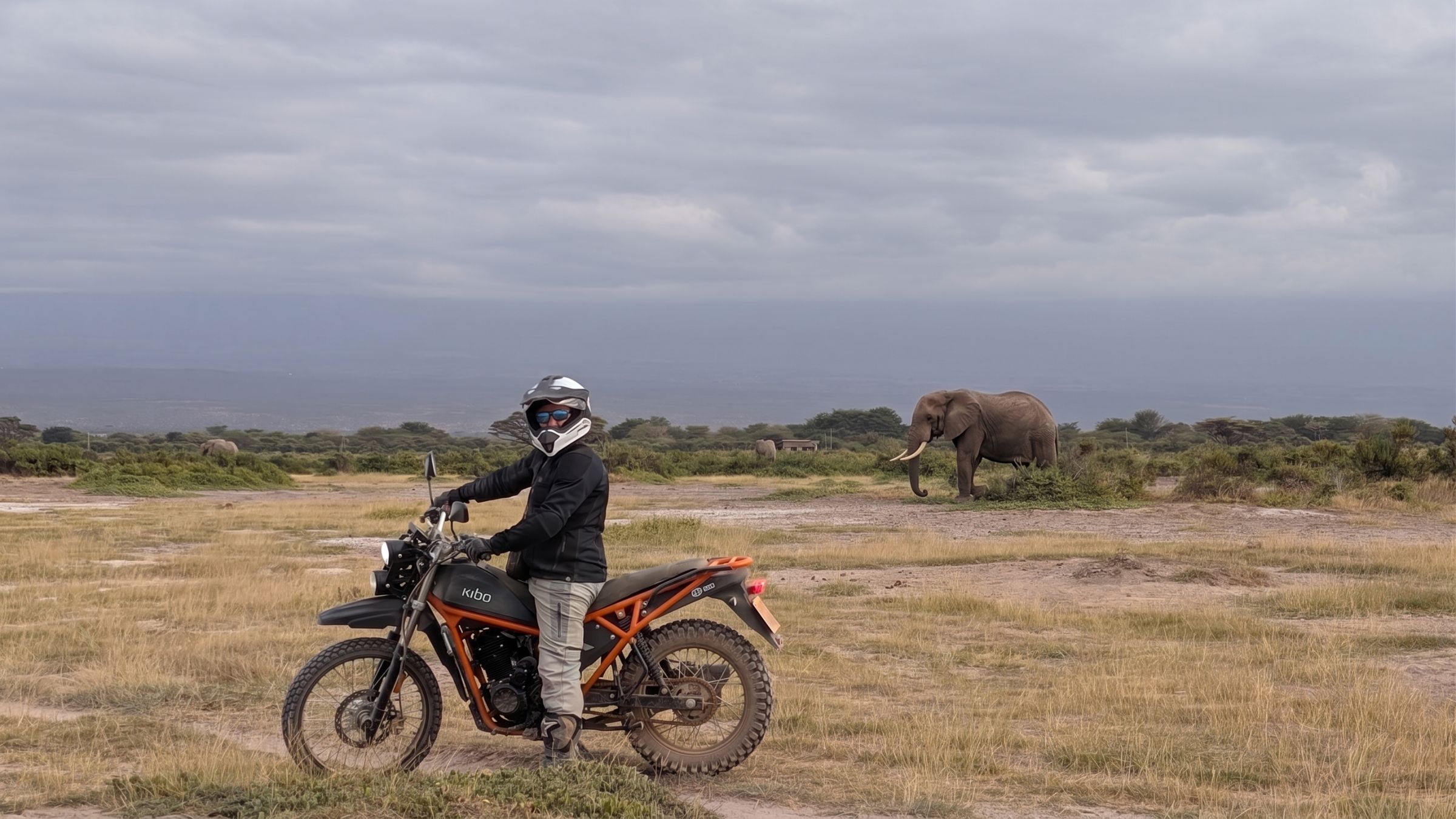
A proper off road motorcycle tour in Kenya means red dirt tracks, murram roads, dry riverbeds and a giraffe next to the road, with most of the riding away from tarmac. For most riders from Europe and the UK, the best way to do it is on a small guided expedition with a mechanic and a doctor riding along. Our 2027 Safari Loop is built that way: 8 days, a maximum of eight riders and about 80% off road.
This guide covers what the riding is like, how guided differs from self drive, the paperwork you need, and what to check before you pay a deposit.
Ride Kenya With Us in 2027
Max eight riders, about 80% off road, with a doctor, a mechanic and a support car along for the ride. 12 to 19 June 2027.
TL;DR
- A genuine off road tour in Kenya is mostly murram, sand, rocks, river crossings and wildlife. Ask any operator what percentage is unpaved. Ours is about 80%.
- Guided means a mechanic, a doctor, a support vehicle and local route knowledge. Self drive means you carry all of that yourself, in remote country.
- You need a valid passport, an eTA, your motorbike licence and, since October 2026, travel health insurance that meets Kenya’s new rules.
- The 2027 Safari Loop is €2,785 per rider for 8 days, full board, with airport transfers included.
Table of Contents
- What an off road motorcycle tour in Kenya really involves
- Guided tour or self-drive: which suits an off road rider?
- What group size does to the ride
- Who this riding is for
- Paperwork for UK and European riders
- Safety on the trail
- Costs and inclusions: what to check
- Our 2027 Safari Loop
- What to pack
- Beyond Kenya
- FAQ
- Sources
What an off road motorcycle tour in Kenya really involves
Leave the main roads in Kenya and off road riding is simply how you get around. Farm tracks, murram roads (compacted red gravel), sandy riverbeds and rocky escarpments link the places worth seeing.
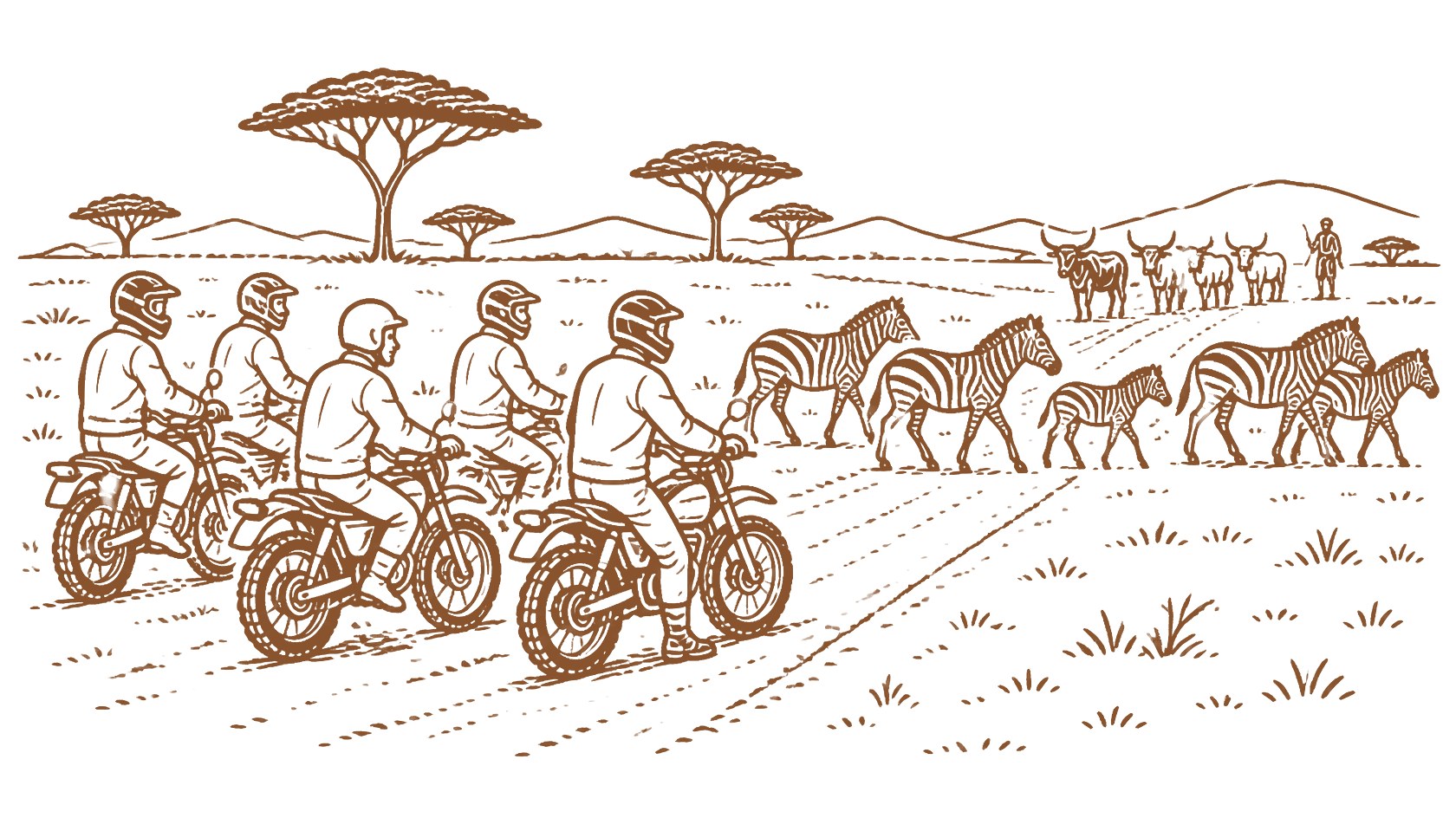
A good tour strings those surfaces together into a route. You ride in the morning, usually when it is cooler. You stop for water and photos, and you reach camp or a lodge before dark. Wildlife is part of the day, not a side trip. Zebra, giraffe and antelope cross the track. Livestock and herders share it too.
The key number to ask for is the share of off road riding. Many “motorcycle tours” in Kenya are mostly paved with a few dirt sections added for photos. On our expeditions, riders spend 80% of the distance off road. That is the figure to compare when you read other itineraries.
The surfaces you will meet
- Murram. Hard-packed red gravel. Fast and fun when graded, loose and corrugated when it is not.
- Fesh fesh. Fine, powdery dust that hides ruts and holes. It looks flat. It is not. Keep your distance from the rider in front.
- Sand. Dry riverbeds and lowland tracks. Keep your weight back, stay on the throttle and look where you want to go.
- Rocks and washouts. Common on escarpment descents and after the rains.
- Black cotton soil. Fine in the dry. Slick and heavy when wet, which is why timing matters. Our month-by-month guide to the best time for a motorbike tour in Kenya explains the seasons.
- Sleeping policemen. Speed bumps on tarmac, often unmarked, and often just before you relax.
For a deeper breakdown by region, see our off road riding terrain guide for Kenya.
The roads between the tracks
Expect some tarmac, because you need it to link regions. Here the rule is the one every Kenyan driver knows: the biggest vehicle wins. Matatus (minibus taxis) overtake on blind bends, trucks do not move over, and boda boda riders appear from nowhere. Add potholes that can swallow a front wheel and goats that wander on without looking, and you see why staying alert matters more than speed.
Guided tour or self-drive: which suits an off road rider?
Searching “off road self drive motorbike” turns up rentals, self-guided packages and guided groups. They are different products with different risks.
Self-drive in Kenya means you handle:
- route finding where signal drops and tracks fork without signs
- fuel planning, since stations can be a long way apart
- mechanical problems far from a workshop
- medical problems far from a clinic
- permission to enter private land and conservancies
A guided expedition takes those jobs off you. On ours, a mechanic rides with the group and a support vehicle carries luggage and spares. A doctor travels with you. Raj and Hidde plan and lead the route. You ride, and we handle the rest.
That is also why guided riders reach places self-drive riders cannot. Our routes include private conservancies and restricted areas. These are areas of land managed for wildlife and communities, with limited access, and they are where much of the best riding sits. Our guide to private conservancies in Kenya explains how they work for riders.
If you are an experienced rider who likes independence, a guided group is still the stronger choice here. You ride at the pace of the terrain, not at the pace of a map, and you keep your energy for the riding itself.
What group size does to the ride
Group size changes the whole day. A large group means long waits, thick dust and a slow pace. A small group means everyone gets the lead position in rotation, the guide knows each rider’s level and the whole group fits in one conversation at camp.
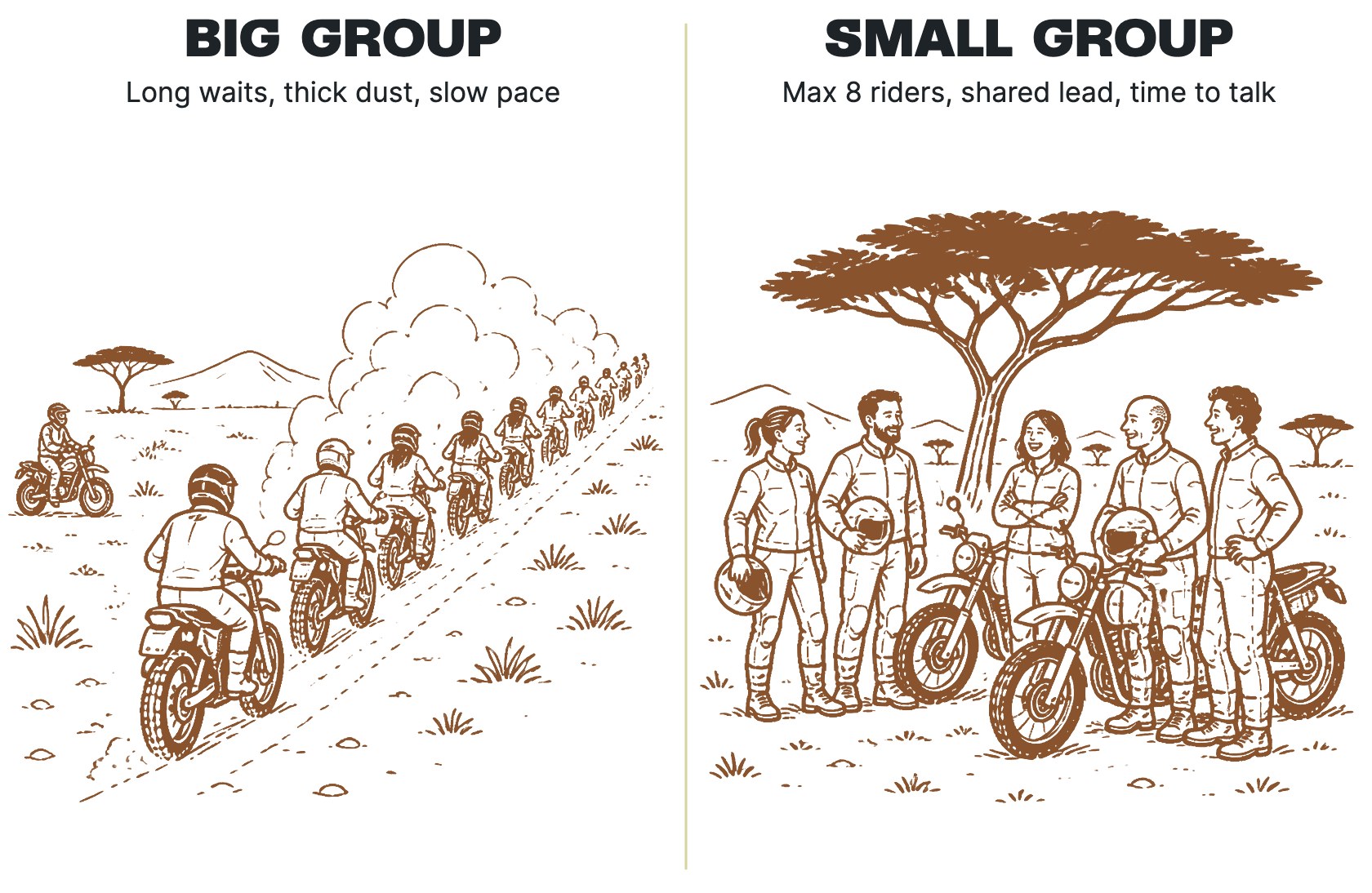
Our expeditions take a maximum of eight riders, and we only run a few each year. It is a passion project, not a tour factory: Raj lives in Kenya, Hidde lived there for years, and we ride with our riders as friends.
Who this riding is for
Off road riding in Kenya suits you if you are comfortable on two wheels and relaxed on gravel. You do not need to be an enduro racer, and the group does not ride fast. You do need to be happy with a few hours in the saddle a day, in the heat, several days in a row.
A few signs you are ready:
- You can stand on the pegs for extended periods.
- You have ridden gravel, sand or mud before and know how the bike behaves.
- You can pick up a bike with help.
- You are happy to ride at a steady pace and stop often for wildlife.
If that sounds like you, the Safari Loop is a good fit. If you want to talk through your level before you book, plan your ride with us. The first half day is a practice ride on sand and gravel, so nobody gets thrown in at the deep end.
Paperwork for UK and European riders
Sort this early, because the rules change. Check your own government’s Kenya travel advice before you book flights.
Licence
Bring your motorbike licence. It is mandatory in Kenya, and without one your insurance will not cover you after even a small spill.A licence in English, like a UK photocard licence, is valid in Kenya for up to 90 days, which easily covers our trips. Is your licence in another language, for example Dutch or German? Then bring an International Driving Permit as an official translation. Dutch riders get one from the ANWB, German riders from their local Führerscheinstelle. Carry your licence with you on every riding day.
Travel health insurance
Since October 2026, most visitors staying in Kenya for less than 12 months need travel health insurance that meets Kenya’s new minimum cover. It is linked to the eTA (electronic travel authorisation) application on the eCitizen portal, so check there whether your own policy qualifies or whether you need the local one.
That does not replace your own travel insurance. Make sure your own policy covers motorcycling off road and medical evacuation. Our guide to planning a motorcycle trip to Kenya covers visas, licences, insurance and kit in more detail.
Passport
The FCDO advice says your passport should be valid for at least six months after you arrive and have two blank pages. Look at the FCDO page for the current wording.
Health
See your GP or a travel clinic well before you go for vaccination and malaria advice for your itinerary. Do it weeks ahead, not days.
Where not to ride
The areas governments advise against are along the Somali border and in the far north east, a long way from anywhere we ride. Our article on whether it is safe to ride a motorbike in Kenya goes through it plainly.
Safety on the trail
Off road riding around wildlife and remote country needs a routine. Fuel. Water. Tools and spares. A first aid kit. A communication plan.
In Kenya, the Motorcycle Sports Federation of Kenya promotes group riding etiquette, bike preparation and emergency response guidelines for riders. The basics are simple:
- Ride within your limits. Pole pole, slowly slowly, is the Swahili way and a good rule on loose ground.
- Keep a gap in the dust. If you cannot see the track, you are too close.
- Never ride at night. Livestock, wildlife and unlit vehicles share the road.
- Respect wildlife. Keep your distance from elephant, buffalo and anything with young.
- Wear protective gear that breathes: helmet, boots, gloves and light armour. Kenya gets hot and dusty, so leave the heavy leathers at home.
On our expeditions, a doctor and a mechanic travel with the group, along with a support vehicle. If something goes wrong, help is already there, so a small problem stays a small problem.
Costs and inclusions: what to check
Before you compare prices, compare what the price covers. Check these items for any off road tour in Kenya:
- Route length and days riding. How many days are actually in the saddle?
- Off road share. What percentage is unpaved?
- Group size. Is there a maximum?
- Support. Is there a mechanic, a doctor and a support vehicle?
- Accommodation and meals. Is it full board?
- Transfers. Are airport transfers included?
- Bike and kit. Which bike is included and what do upgrades cost?
- Extras. Single room supplements, extra nights and insurance.
Our 2027 prices are below, as published on our site. Flights are not part of them.
| Item | Price |
|---|---|
| 2027 Safari Loop, 8 days, per rider | €2,785 |
| 2027 India Special Edition, per rider | €3,450 |
| Single room supplement | €295 |
| Bike upgrade | €275 |
| Extra night at Doc’s Eco Camp, per person | €50 |
Custom trips are available by enquiry, with no published price.
Our 2027 Safari Loop
The Safari Loop is our scheduled group expedition in Kenya. It runs for 8 days with a maximum of eight riders. Riding is 80% off road, with access to private conservancies and restricted areas. It includes full board accommodation, a mechanic, a doctor, a support vehicle and airport transfers.
Fancy Riding It Yourself?
Tell us who is coming and what you would like. We will take it from there.
It costs €2,785 per rider, with a 10% early bird until the end of 2026. You can add a bike upgrade for €275 or a single room for €295, and extend your stay with an extra night at Doc’s Eco Camp for €50 per person. You can see the full itinerary on the 2027 Safari Loop page. If you want a different route or length, ask about a custom trip through Plan Your Ride.
Curious why we run it this way? Read five reasons our expeditions are different.
What to pack
Kenya gets hot and dusty, so think light. We have had riders turn up with full leather suits and thick winter jackets, and they were soaked in sweat before we had even left camp. Breathable, light gear is the way. It can rain now and then, so a rain jacket is a must, and around places like Lake Naivasha the evenings cool down, so a fleece is nice to have.
- Helmet (an enduro helmet with a peak is ideal), boots and gloves you have worn in before
- Light riding trousers and a vented or mesh jacket, or motocross gear with body armour
- Knee and shin protection
- A rain jacket and a fleece for the evenings
- Sunglasses, sun cream and a buff for the dust
- A waterproof pouch for your phone
- Your regular medicines
Keep luggage light. The support vehicle carries your bags, so one soft, waterproof or water repellent bag is perfect. Please, no suitcases: they are a nightmare in a support car. Anything you do not want to wear can ride along in the car too. Our Bikes and Equipment page shows what we ride with.
Beyond Kenya
Some riders ask where Kenya sits among Africa’s riding countries. We think it is the best place to start, and explain why in our guide to Africa motorbike tours. If you prefer high mountain riding, we also run a Ladakh tour in India for 2027.
FAQ
How much of an off road motorcycle tour in Kenya is actually off road?
It varies a lot between itineraries, so ask for a percentage. Some tours are mostly tarmac. Ours is 80% off road, on murram, sand, rocky tracks and conservancy trails, with some tarmac to link regions.
Do I need an International Driving Permit to ride in Kenya?
A licence in English, like a UK photocard licence, is valid in Kenya for up to 90 days, which easily covers our trips. Is your licence in another language, for example Dutch or German? Then bring an International Driving Permit as an official translation. Dutch riders get one from the ANWB, German riders from their local Führerscheinstelle. Whatever you hold, bring your motorbike licence: it is mandatory in Kenya and your insurance depends on it.
Do I need to be an expert rider?
No, but you should be comfortable on a trail bike on gravel, sand or dirt and fit enough for several hours of riding a day. If you are unsure about your level, get in touch before booking and we will talk it through.
What does a Kenya off road motorbike tour cost?
Our 2027 Safari Loop is €2,785 per rider for 8 days. That covers full board, airport transfers, a mechanic, a doctor and a support vehicle. A single room supplement is €295 and a bike upgrade is €275. Flights are separate.
When is the best time to go?
The dry seasons give firmer tracks and easier riding. Our month-by-month guide explains the differences.
Sources
- UK Foreign, Commonwealth & Development Office: Kenya travel advice
- Motorcycle Sports Federation of Kenya: Leisure & Touring