
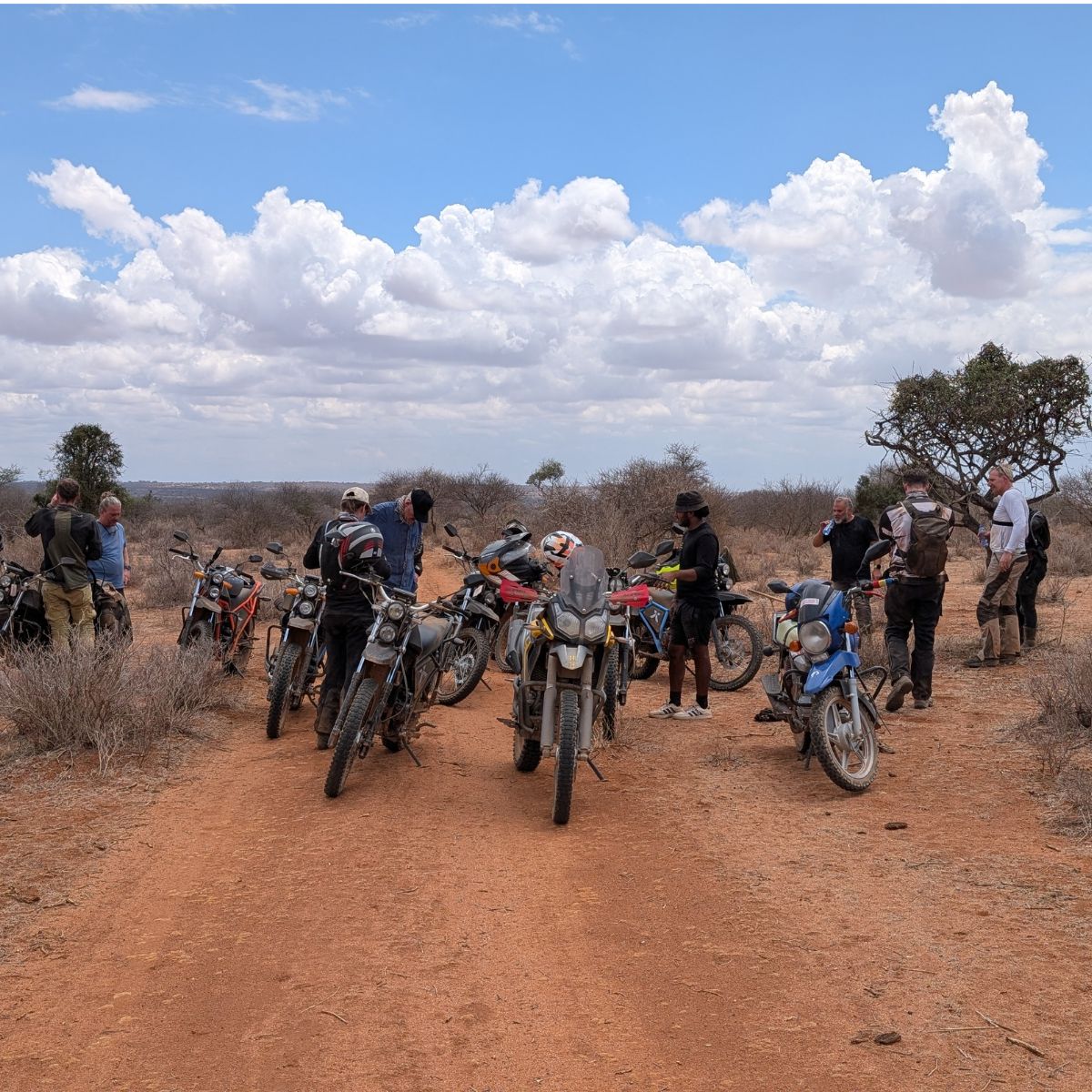
Group riding goes well when everyone has agreed the plan before the engines start: who leads, who sweeps, how far apart you ride, what happens if you get split up. Keep the group small, ride at the pace of the slowest rider, stay staggered on open roads and single file on bends, and nobody rides beyond their ability to keep up. Off-road in a place like Kenya, the same principles apply, with a few extra habits we cover below.
This guide is for riders who want to enjoy a group ride properly, whether it is a Sunday ride-out in the Cotswolds or a week on red dirt tracks with a giraffe next to the road.
Ride Kenya With Us in 2027
Max eight riders, about 80% off road, with a doctor, a mechanic and a support car along for the ride. 12 to 19 June 2027.
TL;DR
- Hold a riders’ meeting first: route, fuel and rest stops, hand signals, and what to do if the group splits.
- Pick an experienced leader and an experienced sweep (the last rider), and put slower riders near the front.
- Ride staggered on straight, open roads, single file on twisty or limited-visibility roads, and never side by side.
- Keep at least a two-second gap to the rider ahead, and do not overtake within the group unless invited.
- Off-road, groups need more space, more patience and a plan for breakdowns and dust.
Table of Contents
- Why group riding needs its own rules
- Before you set off: the riders’ meeting
- How big should the group be?
- Roles: leader, sweep and everyone between
- Formation and spacing
- Group riding etiquette
- Group riding hand signals
- Stops, splits and getting separated
- Taking group riding off road, Kenya style
- Riding in a group in Kenya
- A quick checklist for your next ride
- FAQ
- Sources
Why group riding needs its own rules
Riding with friends is one of the best parts of motorcycling. It is also riskier than riding alone in a specific way: the pace stops being yours. The official UK road safety advice from Safe Driving for Life explains that danger tends to appear when less experienced riders feel they must go faster, or beyond their ability, to keep up.
Road Safety Wales makes the same point from another angle. When a faster bike sets the pace and others chase it, riders risk points on their licence or a collision. Its advice: never treat a group ride as a competition, and speak up if someone is riding badly. Competing is for the track.
The rules below exist to take that pressure away.
Before you set off: the riders’ meeting
This ten-minute chat prevents most group ride problems. Safe Driving for Life advises agreeing the route, fuel and rest stops, and hand signals, and choosing experienced lead and sweep riders. Cover these points:
- The route. Share it with everyone, not just the leader. Write down or share the destination and stops.
- Fuel and rest stops. Agree them in advance so nobody runs dry or rides tired.
- Roles. Name the leader and the sweep.
- Signals. Agree which hand signals you will use, even the obvious ones.
- Regroup points. Pick places to meet if you get separated. Road Safety Wales recommends arranging these before you leave.
- Emergency basics. At least one rider should carry a phone, first aid kit and toolkit, according to Safe Driving for Life.
On the bike side, Somerset Road Safety suggests starting with a full tank, a charged phone with an in-case-of-emergency contact, and a proper bike check, including tyre pressures.
When the ride ends, do a short de-brief. The British Motorcyclists Federation recommends reviewing what worked and what could improve, and briefing any new rider on your group’s procedure.
How big should the group be?
Smaller is easier. Safe Driving for Life recommends no more than five riders and splitting larger groups into smaller ones. The DVSA enhanced rider scheme log book uses the same ideal for staggered formation. ARNY allows five to seven riders, split into sub-groups beyond that.
Why? A long line stretches over junctions and roundabouts, riders at the back have to hurry to catch up, and communication falls apart. Ride with riders of similar ability, and if the skill range is wide, put the slower riders at the front so nobody is dragged along.
Roles: leader, sweep and everyone between
The leader sets a pace that suits the whole group, not the fastest rider. Per Somerset Road Safety, the leader observes speed limits, rides at a speed safe for the conditions and waits if the rear marker drops out of sight.
The sweep rides last, watches for breakdowns and stragglers, and can call for help. The BMF suggests that the most experienced rider often sits at the back, where they spend the ride catching up, with a level-headed experienced rider at the front.
Some UK groups add a marker role. WSAM describes the rider behind the leader dropping into a visible position at a junction or roundabout to direct those behind, then rejoining in front of the sweep. It is worth knowing if your group is larger than five.
Formation and spacing
Staggered on open roads
In a staggered formation, riders alternate positions in the lane. Safe Driving for Life describes one rider in the right-hand third of the lane and the next in the left-hand third. WSAM explains why this is preferred over a straight line: it extends each rider’s braking distance and view ahead while keeping the group short enough to manage, though riders at the back have reduced visibility and need to concentrate.
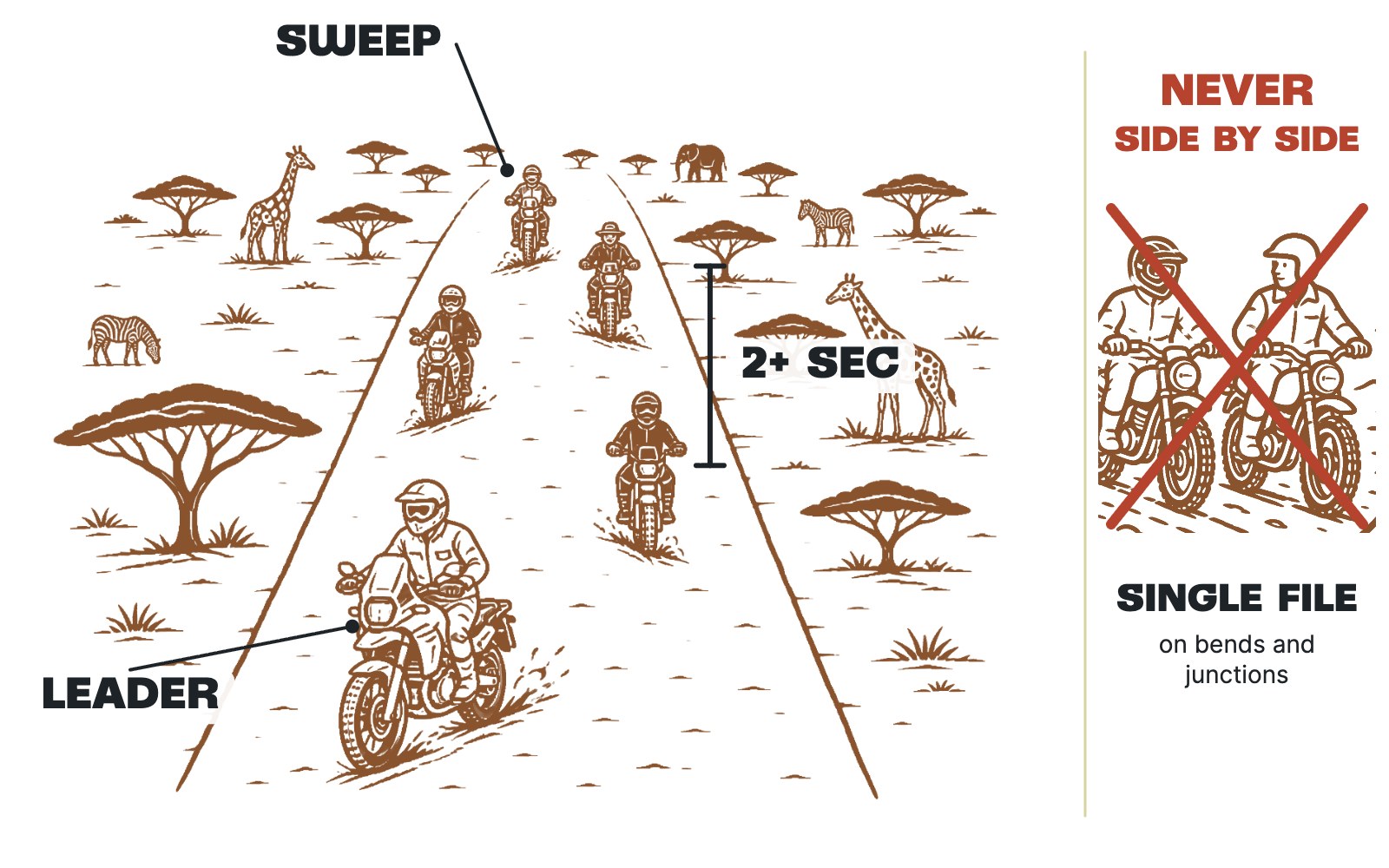
Never ride side by side. There is too little room to avoid a hazard, and ARNY warns that handlebars can tangle.
Single file when it gets tight
Safe Driving for Life says to ride single file on national speed limit roads and on twisty roads with limited visibility. WSAM adds that the formation is temporarily given up for bends, junctions and hazards, and re-adopted once clear. Do not cling to the pattern for its own sake.
The gap: how many seconds?
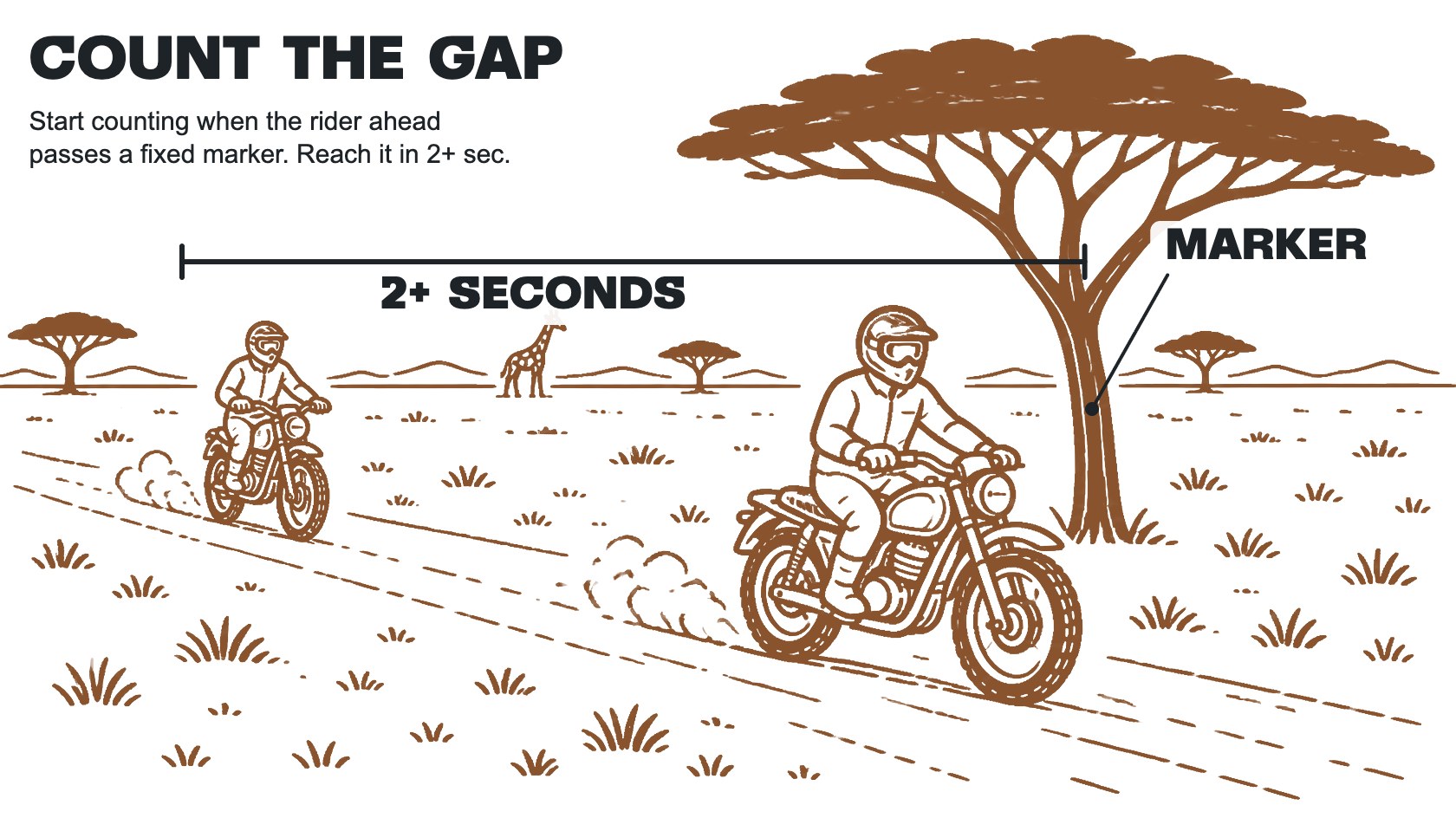
The BMF recommends at least a two-second gap to the rider directly ahead, keeping the rider behind in your mirrors, and making sure they have seen you before you turn. ARNY also uses the two-second rule.
You may have seen “four seconds” in search results. That figure comes from US advice: the Georgia Department of Driver Services recommends a minimum four-second following distance for new motorcycle operators, five or more at higher speeds, on slippery roads or in heavy traffic. If you are less experienced, or the surface is poor, more space is always a good idea.
To count it, pick a fixed marker such as a lamp post. When the rider ahead passes it, count the seconds until you reach it.
| Situation | Formation | Gap |
|---|---|---|
| Straight, open road with good visibility | Staggered | At least two seconds to the rider ahead |
| Twisty road, limited visibility, national speed limit road | Single file | Keep a safe, comfortable gap |
| Slippery surface, heavy traffic, less experienced rider | Staggered or single file as the road demands | More than two seconds |
| Junctions, roundabouts | Group shrinks and regroups | Follow the leader and marker |
Group riding etiquette
Most etiquette is about respect for the slowest and safest rider.
- Ride your own ride. Slow down if you are at the front and someone falls behind. Check your mirrors often.
- No overtaking within the group. The BMF says a common rule is that any change in order happens at a break or on the way home. WSAM adds: do not overtake group members unless invited.
- Overtake other vehicles by your own decision. Do not follow the bike ahead into an overtake blindly. Road Safety Wales says to overtake only when you can see it is safe.
- Do not shut out a rider behind you who is overtaking.
- Tell someone if you need to stop. WSAM suggests telling the sweep.
- If there is a breakdown, Somerset Road Safety says the ride stops to help the affected bike.
- Speak up about inappropriate riding or poor attitude.
What the law says
Group riding is not a separate legal category here. The advice above is recommended good practice from road safety bodies, not a set of laws. What stays legal is each rider’s own duty: speed limits, road signs, licence and insurance apply to every rider in the group, whoever is leading. Road Safety Wales notes that matching a faster rider’s pace can cost you points. “The leader was going that fast” is no defence.
Group riding hand signals
Hand signals are not universal, which is why you agree them at the riders’ meeting. A few you may meet:
- Two fingers up from the leader can mean double-file formation, and a single raised index finger single file, according to Yahoo Autos. Confirm that your group means the same.
- Two fingers pointing down is the rider wave, not an instruction. Pirelli describes it as a greeting meaning keep two tyres on the ground. It advises against waving while cornering, braking, on the highway, in rain or at night. When riding on the left, a brief gesture with the right-hand fingers is enough.
Keep a short list of signals for: stop, slow down, fuel needed, hazard on the left or right, and single file. In a group of five or fewer, simple and clear beats a long code nobody remembers.
Stops, splits and getting separated
Splits happen at traffic lights, junctions and roundabouts. The plan you made at the riders’ meeting is what saves you.
- The leader waits if the sweep disappears from view.
- If the group splits, WSAM says the last rider across waits safely for the next part to catch up.
- If you are properly separated, ride to the agreed regroup point. ARNY says to follow the pre-planned procedure without breaking the law or riding beyond your skills.
- Do not speed to catch up. That is how a split becomes a crash.
Taking group riding off road, Kenya style
Most of the advice above comes from UK road safety bodies, and it holds up. But a group ride in Kenya is a different animal. The road can change from smooth tarmac to murram to deep sand in a single bend, and nobody puts up a sign to warn you. This is where we speak from our own riding.
- Potholes, and proper ones. On tarmac and dirt alike, a hole can appear that would swallow a front wheel. The leader points them out, everyone passes the signal back, and you keep enough gap to see the ground in front of you, not just the bike.
- Surfaces change fast. Red murram, corrugated washboard, fesh fesh (fine powdery sand), rocky riverbeds and black soil can all turn up in one morning. Read the surface ahead and adjust your speed before you are on it, not after.
- More space. Dust cuts visibility and braking. On a murram road you need far bigger gaps than on tarmac. Falling back is better than riding blind through the rider ahead’s cloud.
- Living roads. Goats, cattle, children, boda bodas (motorbike taxis) and the odd giraffe share the space. Slow down early and give them room.
- Tarmac surprises. Sleeping policemen (speed bumps) sit unmarked at the edge of towns, matatus overtake without looking, and the biggest vehicle always wins. Give way, stay calm, go pole pole (slowly, slowly).
- Regroup more often. Tracks branch, and it is easy to take the wrong fork. We wait at every junction until the sweep is in sight.
None of this is meant to put you off. It is just different, and once you have the rhythm of it, it is a cracking way to ride. The daily briefing matters even more here, because there is rarely a phone signal when you need one.
Riding in a group in Kenya
If you want a group ride with real off road riding, our trips are built around it. Our expeditions take a maximum of eight riders and run on about 80% off road terrain. Every morning starts with a short briefing on the day’s route and surfaces, Raj or Hidde leads, an experienced rider sweeps, and the support car with the mechanic and doctor follows behind. It is not a race: on tricky sections the group averages about 30 km/h, and the first half day is a practice ride on sand, gravel and loose ground so everyone finds their feet.
The 2027 Safari Loop costs €2,785 per rider, and the 2027 India Special Edition costs €3,450 per rider. A single room supplement is €295, a bike upgrade is €275, and an extra night at Doc’s Eco Camp is €50 per person. See the 2027 Safari Loop for the itinerary, or look at all 2027 tours.
Fancy Riding It Yourself?
Tell us who is coming and what you would like. We will take it from there.
If you are weighing up how safe it is to ride there, read our guide in is it safe to ride a motorbike in Kenya. For licence, insurance and kit, see our guide to planning a motorcycle trip to Kenya, and for custom trips or questions, use Plan Your Ride.
A quick checklist for your next ride
- Agree route, stops, signals, leader and sweep.
- Charge phones, fill tanks, check tyre pressures.
- Ride with similar-ability riders, slower ones nearer the front.
- Stay staggered on open roads, single file on tight ones.
- Keep two seconds or more, and more again off-road or in the wet.
- No overtaking within the group unless invited.
- Wait at junctions, and stick to the regroup plan.
- De-brief at the end.
FAQ
How many riders should be in a motorcycle group?
Safe Driving for Life recommends no more than five, and splitting larger groups into smaller ones. Some UK clubs accept five to seven with sub-groups. Fewer riders means easier communication and a shorter line at junctions.
Should motorcyclists ride staggered or side by side?
Staggered on straight, open roads, and single file on twisty roads or where visibility is limited. Riding side by side leaves too little room to avoid a hazard and can tangle handlebars.
What does it mean when a biker puts two fingers down?
It is the rider wave: a greeting wishing you a safe ride, often described as keep two tyres on the ground. It is not an instruction to the group. Skip it in corners, when braking and in poor conditions.
Can you overtake within a group?
The usual rule is no, unless the leader invites you. Any change in order should happen at a break. Overtaking other vehicles is each rider’s own decision, made only when you can see it is safe.
Sources
- Riding a motorcycle in groups, Safe Driving for Life
- Planning a Bank Holiday Ride Out, Road Safety Wales
- Organising a group ride-out, Somerset Road Safety
- Riding season is here! But stay safe in Groups, British Motorcyclists Federation
- DVSA enhanced rider scheme: rider’s log book for extra modules
- Social Riding Hints and Tips, ARNY
- Group Riding Rules, WSAM
- Section 5.4 to 5.5, Georgia Department of Driver Services
- What Does It Mean When A Biker Points Two Fingers Up?, Yahoo Autos
- Wave, the greeting between motorcyclists, Pirelli