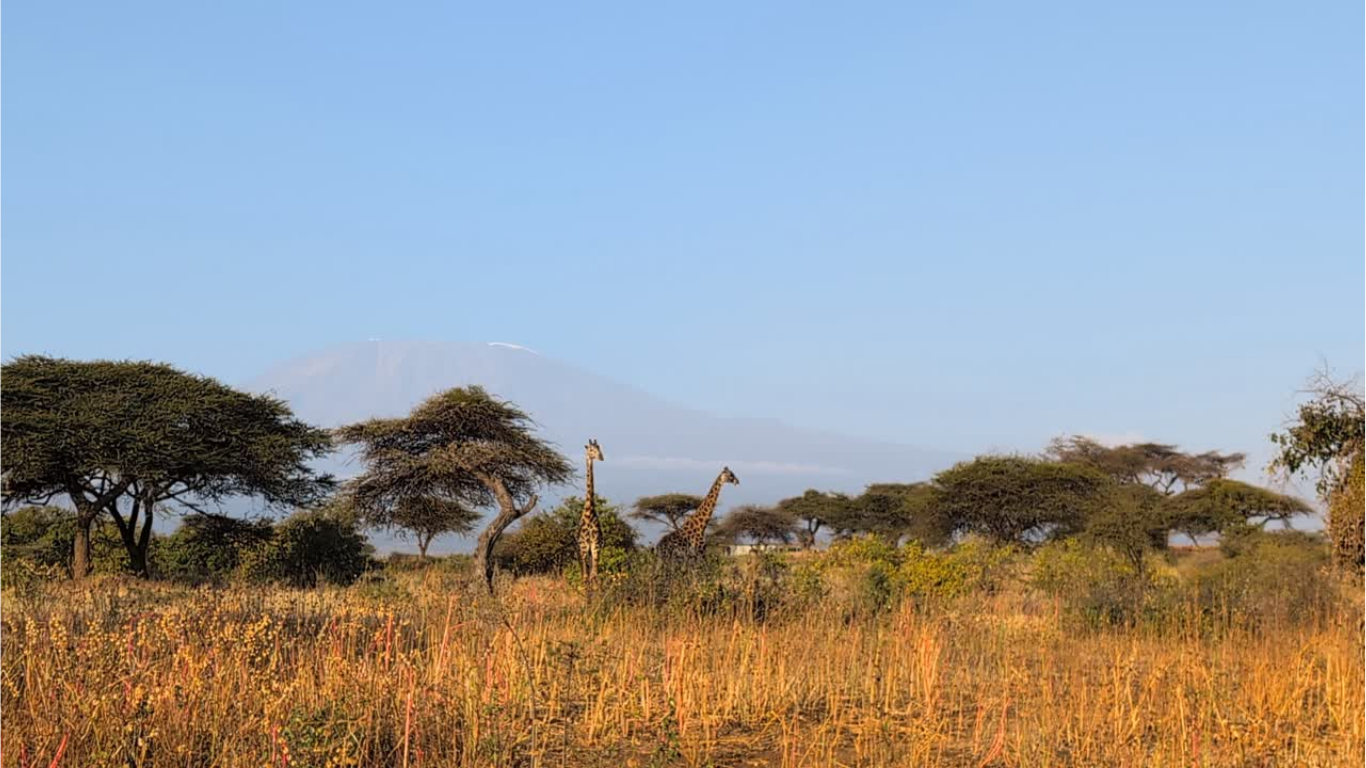
A private conservancy in Kenya is wildlife land held and managed outside the national parks, with its own rules on who comes in, how many vehicles and what you can do there. For a rider, that matters because access is set by the conservancy, not by a national park gate. Our Safari Loop is built around that access: small groups of up to eight riders, around 80% off-road, with a doctor and a mechanic along for the ride. This guide explains how conservancies work, which ones you will hear about and what to expect if you want to see them from a motorbike seat. Spoiler: it is a wee bit special.
Ride Kenya With Us in 2027
Max eight riders, about 80% off road, with a doctor, a mechanic and a support car along for the ride. 12 to 19 June 2027.
TL;DR
- Kenyan law defines a private conservancy as land set up by a private individual or company for wildlife conservation, with a registered management plan and regular reporting.
- Conservancies control access, so vehicle rules, speed limits and activities differ from one to the next, and motorbikes are only allowed where management has arranged it.
- Famous names include Ol Pejeta, Lewa and the Mara North conservancy, each with its own code of conduct.
- Our 2027 Safari Loop costs €2,785 per rider and is designed around access to private conservancies and remote trails.
Table of Contents
- What a private conservancy actually is
- Conservancies you will hear about
- What the rules say about vehicles, speed and walking
- Why riders end up in conservancies at all
- How conservancies protect wildlife and pay their neighbours
- What you can do inside a conservancy
- Why a guided expedition is the way in
- The 2027 Safari Loop
- Riding in conservancies responsibly
- Perspective: why the conservancy is the point
- FAQ
- Sources
What a private conservancy actually is
The legal definition is plain. Kenya’s Wildlife Conservation and Management (Conservancy and Sanctuary) Regulations, 2015 describe a private conservancy as one established on private land by a private individual or company for wildlife conservation. Academic work on the sector uses the same split: Frontiers in Conservation Science classes private conservancies as those formed on private land by individuals or corporates for conservation.
That is different from a national park or reserve, which the state runs. It is also different from a community conservancy, where many landowners pool their land. In practice you will see all three models, and the Maasai Mara is the best-known place where they sit side by side.
How they are managed
A conservancy has real structure behind the name. Under the 2015 regulations, it is registered and has to submit a management plan within three years of registration. It reports on progress every year, monitors wildlife regularly, keeps those records available for inspection and reports incidents to the Kenya Wildlife Service. Day-to-day running can sit with a conservancy manager or a management company.
That structure explains why each place feels different. One conservancy may be a single ranch run by an owner. Another is a partnership of tourism operators and landowners. The rules you ride under come from whoever manages the land.
Why access is different from a national park
Research in the journal Oryx found that many private protected areas in Kenya are held under long-term private ownership or group-ranch ownership, or are leased and managed, with varying access and tenure rights. In the same study, private-sector conservation enterprises had control over access to the area, according to 84% of the managers surveyed.
Translated for a rider: the gate is not a public gate. Someone decides who comes in, in what vehicle, with which guide. That is the reason “exclusive access” on a tour is a real thing and not a brochure phrase. It is also the reason you cannot just turn up on your own bike and ride in.
Conservancies you will hear about
Kenya has dozens. Three come up again and again.
| Conservancy | Where | What to know |
|---|---|---|
| Ol Pejeta | Laikipia County, Central Kenya | Listed in the National Wildlife Database |
| Lewa Wildlife Conservancy | Meru County, Central Kenya | Same database listing, with a detailed public code of conduct |
| Maasai Wilderness Conservancy | Narok County, Rift Valley | Same database listing |
The Mara has its own cluster. Mara North is described as a private wilderness area of more than 29,170 hectares, run as a partnership between 12 tourism partner members and 783 Maasai landowners, and it borders the Maasai Mara National Reserve. Laikipia, north of Mount Kenya, has its own run of private and community conservancies.
The point is not to memorise a list. The point is that Kenya’s wild country is a patchwork. Between the big named places there are corridors, ranchland and dispersal areas where giraffe, zebra and elephant move freely, and that is the country a motorbike can cover in a day that a game-drive vehicle would take much longer over.
What the rules say about vehicles, speed and walking
This is the part most guides skip, and the part a rider needs most. Each conservancy writes its own code of conduct, and they are specific.
Vehicles. The Northern Mara Conservancies Code of Conduct allows responsible off-road driving for sightings. It also states that vehicles other than automobiles, including motorbikes and quad bikes, are not permitted in Enonkishu, Ol Chorro or Lemek unless organised by conservancy management. The key words are “organised by conservancy management”: two wheels get in when the people who run the land have agreed to it, in advance, for a defined group.
Speed. The same code sets a strict maximum of 40 kph. That suits a motorbike expedition well. You are there to look, not to race, and a steady pace on red dirt tracks is how you see a giraffe next to the road before it sees you.
Off-road rules. Lewa’s code of conduct discourages off-road driving except in exceptional circumstances and prohibits it in the rainy season. It also restricts the vehicles that may be used.
On foot. Lewa’s code prohibits walking unless guests are accompanied by an authorised, armed guide who knows how to walk among dangerous game. Guests who walk without one accept the risk and liability themselves. The sensible rule for any conservancy: stay with your guide, and stay on the bike or by the bike unless you are told it is safe.
Booking certain extras. Lewa also asks visitors to book some experiences, such as a game blind, a sundowner spot, a lion tracker, walking routes and visits to orphaned animals, through its Ops Room. Even the small things are arranged, not improvised.
Take these together and the picture is clear. Conservancy access for a motorbike group is a piece of planning: agreeing routes, group size, speed and guides with the managers, usually long before you fly. That is work a person with local contacts does far better than a visitor with a map.
Why riders end up in conservancies at all
Kenya’s national parks are built for vehicles with roofs. Conservancies are built around limited numbers and low impact, and the best of them have varied terrain: murram roads, rocky climbs, dry riverbeds, fesh fesh sand in the dry season. For a rider that is the difference between a day on tarmac and a day that feels like an expedition.
There is also the matter of crowds. A national reserve in migration season can have a queue of minibuses at a river crossing. A conservancy limits numbers by design, so you get space. If you want to understand what that looks like from the saddle, our piece on why a motorbike safari beats the jeep goes through it in detail.
Riding terrain you should expect
Expect a mix. Fast gravel, loose sand, stony tracks, river beds and the odd stretch of tarmac with sleeping policemen (speed bumps) that appear without warning near villages. Matatus and trucks follow one rule on public roads: the biggest vehicle wins. Inside a conservancy the traffic changes. Fewer vehicles, but animals on the track and a speed limit to respect.
Our terrain guide for riders covers the surfaces in depth, and the safety guide answers the questions we hear most from first-timers in Africa.
How conservancies protect wildlife and pay their neighbours
Riders often ask whether their visit does any good. The model is built to make sure it does.
National Geographic reports that the private conservancies ringing the Maasai Mara reserve helped increase protected land, partly by imposing limits on grazing and by giving Maasai herders a steady monthly income through leasing partnerships. Mara North’s own account of its history describes conservancy fees being passed on to fund monthly lease payments to Maasai landowners and professional land management.
Lewa reports a similar pattern of long-term partnership with its neighbours: education, women’s microcredit, community-managed water projects and healthcare through clinics, set out in its 2017 impact report.
The practical upshot: a visitor’s conservancy fee helps keep the land wild and gives landowners a reason not to sell or fence it. When you ride with a small group, you tread lightly and the money has a job to do.
What you can do inside a conservancy
The activity list depends on the conservancy and on its code. On four wheels it often includes day and night drives and guided walks. On a motorbike expedition the main activity is the riding itself, with stops for wildlife, local communities and camp life.
What you cannot do is as important as what you can:
- Ride off the agreed route to chase an animal.
- Exceed the speed limit the conservancy sets.
- Walk away from the group or the bike without a guide.
- Bring a drone, music or loud engine noise where the code says no.
- Ride in a conservancy that has not agreed to motorbikes.
A good guide handles all five before they become your problem.
Why a guided expedition is the way in
If you read the codes above, the case makes itself. Access is controlled by management. Motorbikes need an invitation. Walking needs an armed guide. Off-road rules change with the season. Speed limits are strict. A rider turning up alone has very little chance of getting through the gate, and no support if the bike fails 100 km from the nearest town.
That is the gap our expeditions fill. Each one is planned by Raj, who lives in Kenya, and Hidde, who lived there for years, not by a tour factory, and runs with no more than eight riders so that conservancy managers can say yes and the group stays light on the land. Every trip carries a doctor and a mechanic, plus a support vehicle, so you ride and look rather than worry about fuel, spares or a boda boda mechanic at the next village. If you want to know what sets our approach apart, five reasons we are different sets it out.
What riding with us looks like
- Small groups, maximum eight riders.
- Around 80% off-road riding.
- Exclusive access to private conservancies, restricted areas and remote trails that typical tourist routes miss.
- A doctor and a mechanic on every trip, with a support vehicle.
- Full board accommodation and airport transfers.
- Guides who are local experts.
For the paperwork side, such as visas, licences, insurance and kit, our planning guide for a motorcycle trip to Kenya walks through each step for UK riders. If you want the wider picture of riding in the country, the practical guide to riding a motorbike in Kenya is the place to go next.
The 2027 Safari Loop
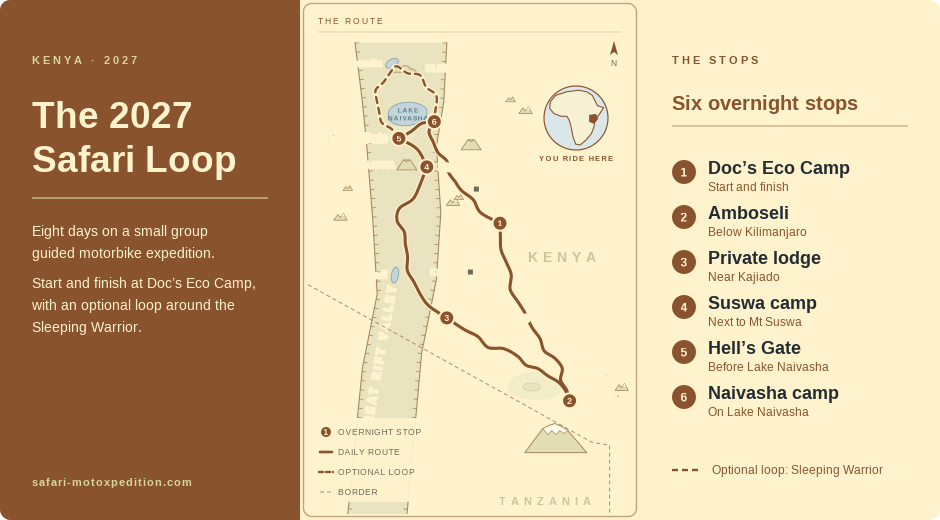
The 2027 Safari Loop is an eight-day expedition priced at €2,785 per rider. It includes full board accommodation, airport transfers, a mechanic, a doctor and a support vehicle. Options are listed on the Safari Loop page: a bike upgrade is €275, a single room supplement is €295, and an extra night at Doc’s Eco Camp is €50 per person.
If Kenya is not your only itch, there is also a 2027 India Special Edition at €3,450 per rider, and we plan custom trips by enquiry. You can see everything on the 2027 tours page, or start from the Safari-motoxpedition homepage.
Fancy Riding It Yourself?
Tell us who is coming and what you would like. We will take it from there.
Riding in conservancies responsibly
A few habits make a difference whichever group you ride with.
- Follow the guide’s lead. Pace, spacing and stops are set for the animals around you.
- Keep to the track. Conservancies protect grassland, and tyre scars last.
- Mind the speed. Forty kph is a ceiling in some conservancies, not a target.
- Give animals room. Stop, switch off if asked, and let them move on.
- Carry the basics. Water, sun protection, gloves and a charged phone. Fuel, spares and tools stay with the support team.
- See a doctor before you go if you have a medical condition or take regular medication, and tell your expedition doctor about it in advance.
Perspective: why the conservancy is the point
Kenya’s national parks are famous for good reason. But the country’s wildlife story over the last two decades has been written on private and community land, in places where landowners, managers and visitors share a stake. Riding through one, on a bike, at 40 kph with the engine ticking over and a herd of eland stepping off the track, is a different kind of safari. It is quiet, close and earned.
That is why we built our trips around it, and why we keep groups small.
FAQ
What are some private conservancies in Kenya?
Well-known ones include Ol Pejeta in Laikipia County, Lewa Wildlife Conservancy in Meru County and Maasai Wilderness Conservancy in Narok County, all listed in Kenya’s National Wildlife Database. In the Maasai Mara region, Mara North is a large private conservancy bordering the national reserve.
What is the difference between a conservancy and a national park in Kenya?
A national park or reserve is state-run. A private conservancy is set up on private land by an individual or company for conservation, registered with a management plan and regular reporting. Because the managers control access, vehicle rules, group sizes and activities vary from place to place.
Can you ride a motorbike in a Kenyan conservancy?
Yes, where conservancy management has arranged it. Some codes of conduct state that motorbikes are permitted only when organised by management, and speed limits such as 40 kph apply. A guided expedition handles that arrangement for you.
Do conservancy fees help local communities?
In the Mara, fees support monthly lease payments to Maasai landowners and land management, according to Mara North’s own account. National Geographic has also reported that these leasing partnerships give herders a steady income while keeping land open for wildlife.
Sources
- Wildlife Conservation and Management (Conservancy and Sanctuary) Regulations, 2015
- Winning space for conservation: the growth of wildlife conservancies in Kenya, Frontiers in Conservation Science
- Private protected areas: management regimes, tenure arrangements and protected area categorization in East Africa, Oryx
- National Wildlife Database, conservancies
- Mara Conservancies, Maasai Mara Wildlife Conservancies Association
- Northern Mara Conservancies Code of Conduct
- Code of Conduct, Lewa Wildlife Conservancy
- The Rising Stars of Kenya’s Greater Mara, National Geographic